We depend on the support of our readers. Please donate today. Monthly donations are particularly helpful. If, to protect your privacy, you can’t use PayPal, we can receive funds by mail. Contact us: ([email protected] – or – [email protected] – or – [email protected]).
An Analysis of Primitive Responses Among White
Nationalists and Other Pure Yang Personalities and The
Requirement for The Balance of The Yin
by Benjamin
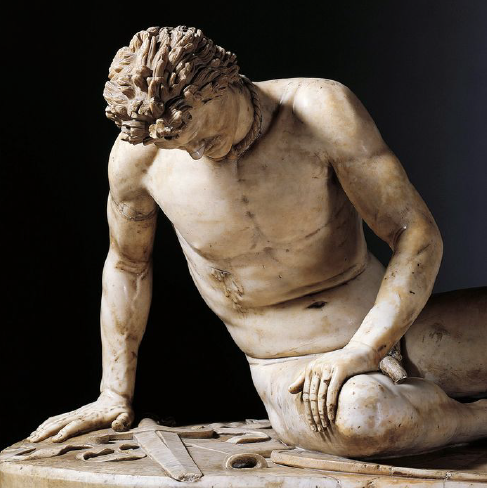
The Dying Gaul is an ancient Roman marble statue in the Capitoline Museums in Rome. This image will appear on the cover of the book The Neanderthal Right when it is finished.
Chapter 1, part 2
I’m also aware that, sadly, the vast majority of Right-wing individuals (etc. – all the usual political synonyms for racially motivated Aryans, or those who wrongly claim to be) and the groups they cluster to are extremely hostile on the whole to manifestations of psychological pain, and ignorant over trauma, and with a particular recent drive, these past few years, to ridicule and condemn mental distress (or ‘mental illness’ as they would term it, unthinkingly adopting a by now firmly debunked and fallacious bio-medical psychiatry paradigm for genetic determinism) for the purposes of ‘defeating’ their political ‘leftist’ rivals, who are, after all, and as if by tautology if one thinks about it, more likely to exhibit mental disruptions, this data inferred from the fact that they are far more likely than the Right to have been referred to a psychiatrist, and labelled by them subsequently. One would have to thoroughly understand the psychiatry industry’s detrimental long-term ideological drives, particularly when it comes to ‘patient’ over-representation and an irrepressible zeal to over-diagnose often imaginary conditions (made up to facilitate the pharmaceutical industry’s continued marketing and lucrative dissemination of toxic, mind-altering drugs) to understand what I mean by this statement of ‘tautological thinking’ though.
Personally, I suspect that there may be as many cases of trauma on the Right as among their leftist enemies, but that it is simply the Right’s notorious conservative ‘stiff-upper-lip’ and adoption of Stoic philosophy that prevents these cases ever coming to light, processed – if at all – in a different manner, tending towards repression and denial, or simply left unsaid, in an unsympathetic crowd, leftists after all being more noted for their traits of openness and emotional reflection, traits now ‘bred out’ of the Right, in a cultural sense. One could easily see neochristianity itself (or rigid adherence to Christianity proper, despite evidence of its anti-Aryan nature, at all points along its history) as a mass psychosis of sorts, even beyond the psychiatric framework of distinct ‘disorders’, and no one in modern society is truly free of this taint.
I suppose, reluctantly, I took [my friend’s] dispassionate advice in the long run. Still, it wasn’t really what I was looking for at the time. I notice this often among Aryans on the Right. There doesn’t seem to be any expressed fondness, or camaraderie, or even a modicum of interpersonal respect. We treat each other as if we are addressing niggers. He didn’t get the kind of mood I was in, which was borderline suicidal, and his ‘I don’t care, sort yourself out’ mentality wounded me quite deeply, coming from someone I had considered an online friend.
Among the backslapping ‘old boys’ network’ of the Dissident Right, like the atmosphere of a post-football match drinking-and-bragging session in the corner of an English theme-pub, it is indeed rare to encounter true seriousness, and mob disgust and wilful ignorance is rampant. One will readily be tarred with the same brush, in ignorant bitterness, from those who equate trauma with moral weakness, genetic inadequacy, or degeneracy. It is no better in Europe, or America.
As we can recall, Dr. William Luther Pierce had something negative to say about most recruits to his organisation, noting the lack of sincerity and good character. Contemporary nationalists and other racists – even some supposed ‘National Socialists’, among those who at true scale number very few on this planet so far, and can be otherwise discounted from this observation – do not seem to hold any genuine compassion or fondness for other Aryans beyond recognizing their utility as mindless, obedient, and conformist chess pieces to bulk out the various impotent schemes of their irrelevant political drives. Ethnocentric loyalty has been made conditional, on faulty premises, by those who do not seem to possess it at all really.
I see nigh-on all these committed Aryan political activists, with their Christian-poisoning, their in-group aloofness, and their get out clause of Judeo-reductionism, as just as much of a threat as everyone else arrayed against our people. If they ever were to achieve substantial power, I would not expect them to impose an order in any way relatable to the worldview of National Socialism, or of any genuine intrinsic loyalty to the great vision of Adolf Hitler (albeit with the taboo acknowledgment that, yes, he did make a few unavoidable mistakes in his policies consequence of the age he inhabited, the state of their knowledge having not amassed to what we have now). Conversely, I would more realistically expect a cruel, petty, and cack-handed dictatorship, if that even. Under their current way of thinking, it is unlikely that we will survive to get that far.
I have, involuntarily, and at great personal annoyance, had many prolonged dealings with the employees of the UK Police Force over the years. Oddly, there’s something in the tone, mentality, and behaviour of white nationalists (or ethnonationalists, if one is in Britain) that is directly evocative, in my experience at least, of the attitudes one finds when one enters the company of UK Policemen. I am not sure that they would be any better behind sealed doors either. I don’t think the former group have noticed this resemblance, and I imagine pointing it out to them would be impossible. Maybe this is a remark on Anglo-Saxon mentalities in general (although even some of purer, Nordic blood adopt this cold, obnoxious and enervating manner!), as much as how prevalent the Neanderthals are.
And ‘Neanderthal’ is not too unrealistic a term by analogy… [to be continued]
Something that could save us, besides the collapse of the dollar, is for Europeans to receive a severe mental shock to cure their insane arrogance in provoking Russia, as demonstrated in this article by Steve Jeremy, “The Coming War With Russia: A European Road To Ruin.”
I’m not a Russophile in the slightest. But Western Europe is as insane as the US, Canada and Australia, and deserves to be punished.
An Analysis of Primitive Responses Among White
Nationalists and Other Pure Yang Personalities and The
Requirement for The Balance of The Yin
by Benjamin
The Dying Gaul is an ancient Roman marble statue in the Capitoline Museums in Rome. This image will appear on the cover of the book The Neanderthal Right when it is finished.
I was introduced to the thinking of the American Alt-Right by a US Strasserite in around 2017. Before then, it is safe to say that I was to all intents and purposes a normie. I had had a tough few years previous, to say the least (and which I have recounted in my autobiography)[1] and I think that I was looking for direction in life, perhaps even a purpose that I could throw my all into. I was extremely naïve, and not as well-read on historical matters as perhaps I should have been, but willing to learn, and with a great curiosity for hidden details, and for those matters considered off-limits by orthodox society, and not often discussed (at least in my usual circle). I was, at least, not offended by anything he wrote to me, although it took me a little while to get on board, as at first I was immature, and prone to making poor taste remarks and faux pas, especially when it came to discussing the ‘Nazis’ and their impact on Western civilisation. I was 31 years old, and quick to learn, although invariably I was to be disappointed.
Even back then I found his attitude crass, a mixture of low-brow anti-cultural remarks and pop music interests, posturing, and in deep deference to Christianity. It was him indeed who encouraged me to briefly return to Christian worship, or at least, to be open-minded towards it, after many years of firm atheism since my late teens, considering Catholicism from a religious perspective and discussing the benefits of communal prayer and the positive influence of Christianity on American society, words I now realise were complete nonsense. His perspective lingered with me, still subconsciously dwelling on my own unresolved issues in the background, from many years before. However, it would take until about late 2019, slightly traumatised and in withering grief just after the death by suicide of one of my neighbourhood friends, before I finally took that desperate, regressive plunge, and began tentatively to attend Mass. Thankfully – in a sense – an allegation of terrorism later on into the following year, and the grim, extended lesson it taught me in aftermath, put paid to my ill-considered revival. I regret losing even those brief months to such idiocy.
My friend never shared that particular ideology with me, bar naming it, particularly in relation to a pop band he loved, but I was shown a load of digital cartoon graphic glyphs in ‘New Wave’ palettes with repetitive slogans plastered over them and was familiarized with obnoxious open discussions on social justice and Muslims, with a small mention of Jews and blacks.
I say ‘obnoxious’ as it occurred to me at the time that they may look ridiculous, for the sake of being meme-worthy, and there were certainly enough slang terms and neologisms and ways to deliberately insult them, but they certainly weren’t acting silly, and these people didn’t appear to be winning, or indeed denting their onslaught at all, as opposed to just doing the papers a business favour by daily second-hand reportage, and showing the world how tough their enemy were, akin to addictive demoralization propaganda for the outraged at their tea-tables. His approach to the problems didn’t really rub off on me, but it sparked enough curiosity to go off into the background and spend many months privately researching the Second World War, the NSDAP, and the terrible Allied destruction of Germany.
Much as Strasserism is nothing but incoherent subversion, looking back, I just can’t match anything he said to that kind of thinking. Perhaps it was simply a fad and a term he liked. We fell out a few years later. Initially, I had made the remark by internet messenger to him that I wanted us to “drive the enemy into the fucking sea!”, and I think he took umbrage at this for some reason, thinking it an extreme response, and admonishing me with a “oh, come on now, you can’t say that…”, coupled to my recorded presentation to him of a particularly acerbic song-poem titled Lesson One in which I sincerely recommended us (or indeed incited, depending how one looks at it) to drag our racial and political foes out of their dwellings en masse and hang them from the walls of this country, to “put out their eyes and rip out their tongues!”, to “desecrate their emptiness!”, and to “excise this blighted flesh and build a pyre of it all!”, remarking, just in case there was any doubt, that “everyone, and everyone, and everyone will fall!!!”As he told me condescendingly at the time, “I see you’re just working off steam…” It simply didn’t occur to him that I might be being serious, having penned the poem as a slab of macabre, aurally degenerate, yet sincere audio propaganda, intending to use it in public to rouse others to violent direct action, rather like those repetitive ISIS marching songs such as Saleel al-Salawim that the Muslims play here when they’re mobbing to attack us.
The final straw was when, some months later, in despair at the lack of such action, and observing the idiotic, brain-dead thralls all around me in my dead country, atomised, sheepish, and unable to think as a collective, my resolve faltered, and I asked him in panic “what the hell do we do now? How do you get these people to wake up! It’s hopeless here… I think we’re going extinct!” hoping for at least some racial solidarity, some hope or psychological assistance delivered long-distance, in setting me back on track. Instead, he replied to me, in evident irritation “Stop whining. Just fucking survive!” and washed his hands of me forever. I gather he hated the British on principle and the devastating plight of our people here, finding it all very wearisome, as if burnt out, and yet, ironically, was hoping for a political superstar saviour, to deal with his own nation’s problems so he didn’t have to. Another one who was convinced that, given the opportunity to, Donald Trump, the inept, narcissistic Jewish stooge of American decline, would ‘sort it all out’.
Last I heard, he’s “dropped out” now, and gone back to being switched off, with his job, and his truck, and his Jesus fetishes, as he prefers to fit in. It’s disappointing that he seems to have seen his adopted (and cynically abandoned) views as some form of game, as if part of a club. I was occasionally told off by him for being “too serious” or “going too far.” To think that at one point I presented as a complete normie to him.
I don’t like America or England. Hate is a better term – I think the countries are both unforgivable. I couldn’t see what he had to be proud of compared with this nation. The Allied guilt issue is totally whitewashed and buried. What Eisenhower and his men did, of their own accord, to the 750,000 German POWs of his Rhine Meadows death camps has not been suitably accounted for, let alone the rest of the appalling destruction of Germany,[2] from the torturous fire-bombings of Dresden and Hamburg, and more than a hundred other German civilian cities, to the systematic dismantling of Germany’s entire industrial infrastructure through the publicly shelved yet privately implemented Morgenthau Plan and Hooton Plan, and broadcasting of the popularly accepted (yet thankfully undelivered) Kaufman Plan, envisaged as a means of sterilising 48,000,000 Germans, and then the brutal massed rapes, gang rapes, and sadistic abuses directed against hundreds of thousands of German women and girls, from age 7 to 69, by the occupying armies of Russians, British, French and Americans, including over 190,000 rapes conducted by the American forces alone, often at gunpoint. The forced mass expulsion and subsequent deaths of more than 14,000,000 German civilians can never be apologised for. We have simply done too much.
The American never mentioned this side of his history to me, proud as any other patriotard, satisfied in his Christianised, anti-Aryan melting pot, a failed country from its very origins. An anti-Europe from conception, and now a New Zion, in the words of Sebastian Ernst Ronin. I’m aware that his ludicrous position is not uncommon.
____________
[1]Consumption: Memories of My Childhood, Books I & II, Benjamin Power, Lulu Publishing, 2025.
[2]See pages 296-304 of my previous work, The Less Than Jolly Heretic, available by private sale, for a full overview of these horrendous crimes, and a list of relevant reference literature.
Whereas the Catholic Church tells us that everybody possesses “reasonable souls”—which seems to be yet another Christian-derived axiological political doctrine at the base of the cult of democracy—and that everybody has “infinite dignity” by virtue of their being created in the image and likeness of a Canaanite storm god, Heraclitus has an opposite opinion:
Not that Heracleitus believes in the wisdom of the majority as an infallible guide. “Most people are foolish and bad; the good are few, and one man is worth ten thousand if he be the best.”
Alfred Benn (1843–1915), Early Greek Philosophy (1908).
Modern Christianity is like stage-three cancer. “Secular Humanism”, as Revilo P. Oliver wrote in Liberty Bell is merely the Christianity of the Marxian Reformation. It is the red giant. It is Neo-Christianity. It is atheistic hyperchristianity.
You and I, César, simply wish to get rid of the Christian Cancer; this alien Semitic parasite on the body of the white race; this “Asiatic psychosis”—as Ben Klassen put it—preying upon the mind of the white race. However Christian traditionalists, like Joel Webbon, or traditional Catholics, wish us to simply go back to an earlier form of the Christian Cancer, like to stage-1 or to stage 2 Cancer. Christianity wasn’t so much of a nuisance to the white race back in the good old days, Christian traditionalists assure us.
However, we cannot unscramble that egg, and even if we could, modern Christianity emerges naturally from traditional Christianity like a chick from an egg. Modern Christianity is just the axiology of early Christianity, found in the New Testament, taken to its logical conclusion.
Today I proofreaded the PDF of Might is Right and made some corrections to my preface and footnotes, as well as adding a quote from Sebastian Ronin at the end.
This means I deleted yesterday’s version and linked today’s corrected version to yesterday’s post.
Below, my preface to my anthology of selected passages from the book Might Is Right:
It is interesting to compare this book published in the 19th century with the lectures of those on the American racial right of the 21st century, who are still stuck in Christian ethics.
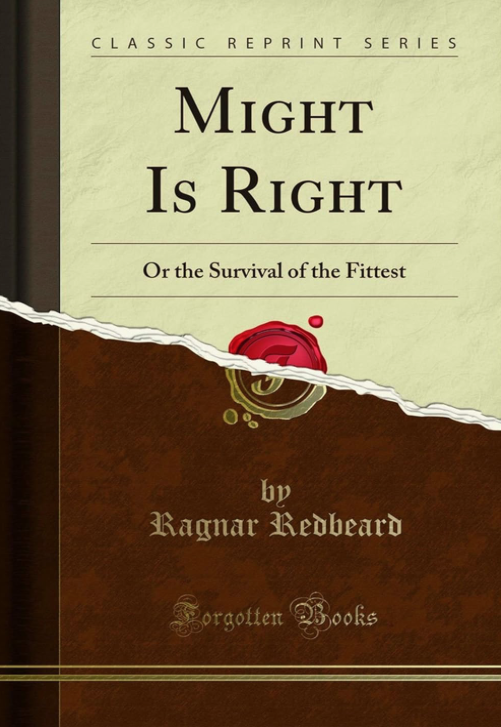
Might is Right or The Survival of the Fittest is a book written under the pseudonym Ragnar Redbeard and published in the US in 1896. It is a treatise on social Darwinism in which ‘Redbeard’—actually Arthur Desmond (1859-1929)—argues that weakness should be treated with abhorrence and strength should be glorified. Unlike Nietzsche’s philosophy (cf. my essay Crusade against the Cross) Desmond possessed racial ideals. He was explicitly anti-Christian and anti-Jewish, claiming that Christianity is contrary to natural law and a harmful foreign influence on Aryans. Desmond also opposes feminism and endorses the traditional role of women as opposed to the modern notion of sexual equality.
In the following pages, slightly abridged, we can read the first chapters of Desmond’s book. Both the images and the italicised text are the editor’s additions (the original text lacks italics). I find it fitting to publish this selection on Independence Day in the United States because the American author was perfectly aware that his nation was born with a catastrophic value system for Aryan preservation: something that white nationalists are still incapable of seeing.